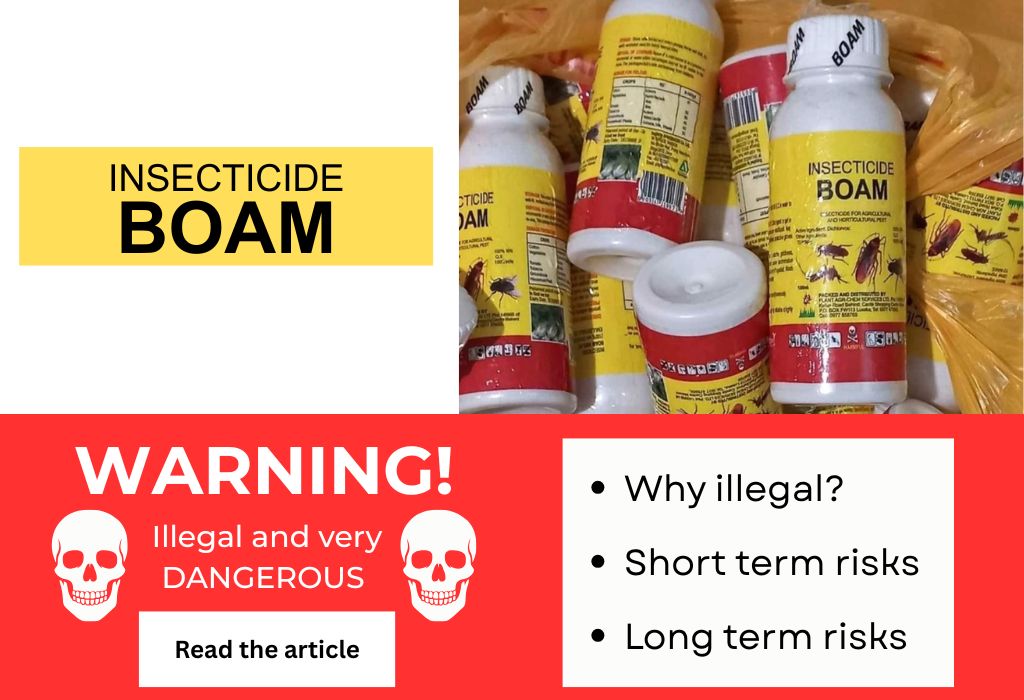
What is “Boam”
- In Namibia, Boam is a name for an illegal pesticide product that is actually dichlorvos.
- Dichlorvos is an organophosphate insecticide. It’s also known by names like DDVP, Vapona, etc.
- Dichlorvos is banned from most developed countries around the world because of it’s danger to humans and animals. (nervous system)
Is it legal / registered in Namibia
- The Ministry of Agriculture, Water and Land Reform (MAWLR) declared Boam illegal in Namibia. Why? Because it is not registered under the relevant legislation (the Fertilisers, Farm Seeds, Agricultural Remedies, and Stock Remedies Act 36 of 1947).
Read the article in the Republikein - MAWLR has advised the public not to buy, use, possess, or store it. It has also asked people to report or surrender it. economist.com.na+1
- BOAM is also banned in South Africa.
Safety / Risk Profile
Because Boam is dichlorvos, its risks are those of dichlorvos. Important things to know:
Mechanism
- Dichlorvos works by inhibiting acetylcholinesterase, an enzyme essential for nerve function. When it’s inhibited, nerve signals can get messed up, leading to overstimulation of nervous system possibly in insects and in humans at sufficient exposure.
Acute (short-term) risks
- Exposure (by breathing in vapour, skin contact, ingestion) can cause symptoms like headache, nausea, vomiting, sweating, blurred vision, salivation, difficulty breathing, convulsions in serious cases.
- It’s considered moderately to highly toxic, especially in concentrated forms.
Chronic / long-term risks
- Repeated exposure can affect the nervous system, potentially lead to lasting damage. There are studies pointing to genotoxic effects (damage to DNA), possible carcinogenicity in animals, and effects on reproductive health.
- Because it degrades somewhat in environment (soil and water), but is volatile and mobile, there are concerns about exposure via air / water / residues.
Origins / Use
- Dichlorvos has been used for many decades globally — in agriculture, public health (for pests), stored product protection, households (via strips, sprays).
- For Boam, specifically in Namibia, it seems it’s being imported (or sold locally) despite lacking registration. Sources point to strong informal or semi-formal distribution (open markets, online). Read about it in the Namibian newspaper
Verdict: Is it safe?
Short version: No, not for domestic (household) use, especially unregulated and unregistered.
In fact, it is better to do your own pest control than using a dangerous, illegal product.
Here are some of my reasoned concerns:
- Because it’s not registered, there’s no guarantee that the version sold is of proper quality (concentration, purity), or that label/usage instructions are accurate.
- Indoor use (poor ventilation, proximity to humans, children, pregnant women) magnifies risk.
- Long‐term or repeated exposure (or accidental misuse) can lead to serious health harms.
- Environmental risks (aquatic life, non-target organisms like bees) are non-trivial.
Can I be prosecuted for using BOAM?
- Yes, you can be prosecuted by law for using or selling an illegal pesticide – Fertilisers, Farm Feeds, Agricultural Remedies and Stock Remedies Act, 1947 (Act No. 36 of 1947)
- Section 7: This section says “No person shall sell any fertilizer, farm feed, agricultural remedy or stock remedy unless it is registered under this Act under the name or mark under which it is sold …”
- Section 7bis: The Minister has the power by Gazette notice to prohibit acquisition, disposal, sale or use of agricultural remedies or stock remedies (including pesticides) — or to allow such under certain conditions (permits). An unregistered pesticide could be declared prohibited.
- Section 18 – Offences and Penalties: If someone violates the Act (selling unregistered remedies, using them contrary to label instructions, selling or possessing them), that person is guilty of an offence under this section. It prescribes penalties: fines, possibly imprisonment.
Penalties
What could happen legally if one is found in violation under these laws:
- From Section 18:
- If the violation is under the more serious “paragraphs” (which include selling something unregistered or not complying with the registration requirements, etc.), the fine can be up to N$1,000 or imprisonment up to 2 years, or both.
- For less serious contraventions, fines or imprisonment may be lower (e.g. up to 12 months) depending on the specific clause.
- Moreover, the law allows that, if an offence is committed, farming requisites (here, the pesticide chemical, stock) of similar nature that are in possession may be forfeited to the state and destroyed.