Adeadly virus that most Southern Africans had never heard of is now at the centre of an international health emergency — and Namibia, sharing a long and porous border with South Africa, has every reason to pay close attention. In early May 2026, the world woke up to news of a hantavirus cluster aboard the cruise ship MV Hondius, a Dutch-flagged expedition vessel that had sailed from the southern tip of Argentina. By the time the outbreak was confirmed, three people were dead, and the virus had touched down — literally — on South African soil.
For Namibians, this is not a distant crisis. It is a warning. Our shared geography, our connected transport networks, and — critically — our shared ecological environment of rodents and rural settlements mean that what threatens our neighbour threatens us too. This article explains what happened, why it matters to Namibia, and most importantly, what you can do to protect your family, your home, and your business.
What Happened: The MV Hondius Outbreak
The MV Hondius departed Ushuaia, Argentina, on 20 March 2026, carrying 147 passengers and crew from 23 countries. Its route took it through Antarctica, remote Atlantic islands including Saint Helena, Tristan da Cunha, and Ascension Island, before heading toward Cape Verde and ultimately the Canary Islands.
The first passenger fell ill on 6 April 2026. By 11 April, a Dutch national had died while still on board — his remains stranded on Saint Helena, pending repatriation. A German woman died on 2 May. A British passenger was medically evacuated to South Africa. His wife, a 69-year-old Dutch woman, also made it to Johannesburg — only to collapse at OR Tambo International Airport, where she later died.
By 4 May 2026, the WHO had confirmed seven cases — two laboratory-confirmed and five suspected — with three deaths, one patient in critical condition, and three reporting milder symptoms. The symptoms described were severe: fever and gastrointestinal illness rapidly progressing to pneumonia, acute respiratory distress syndrome (ARDS), and shock.
What made health authorities particularly alarmed was the identification of the Andes strain of hantavirus — confirmed by South Africa’s NICD through serology, sequencing, and metagenomics. The Andes strain is native to South America and is the only known hantavirus capable of limited human-to-human transmission, particularly through close and prolonged contact with an infected person during the early stages of illness.
“The Andes virus is the most commonly found and deadly variant in South America, where very dangerous versions of hantavirus are proliferating.”
Understanding Hantavirus: The Rodent Connection
Hantavirus is a zoonotic virus — meaning it is carried by animals and transmitted to humans. The primary reservoir is rodents: rats, mice, and similar small mammals. The virus is shed in the urine, faeces, and saliva of infected rodents. It does not make the rodent visibly sick, meaning an infested home or business can appear completely normal even as the virus is being shed into the environment.
How Humans Become Infected
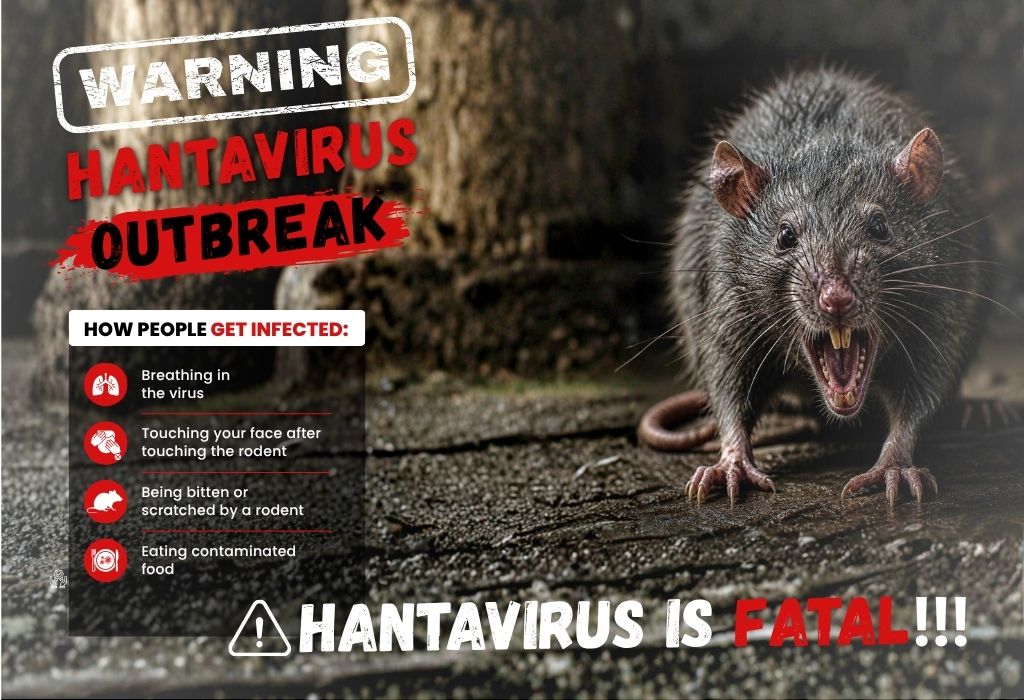
The most common and dangerous route of infection is inhalation. When dried rodent droppings, urine, or nesting materials are disturbed — by sweeping, cleaning, or simply moving through an infested space — microscopic virus particles become airborne. A person walking through a rodent-infested storeroom, barn, ceiling, or outbuilding can inhale these particles without ever seeing a single rodent.
Direct contact with contaminated surfaces followed by touching the mouth, nose, or eyes can also cause infection, as can a rodent bite (though this is rare). The Andes strain carries the additional, chilling risk of person-to-person transmission through close, sustained contact — which appears to be what occurred on the cruise ship.
Critically, as researchers have noted: “Even clean homes and cabins can pose a risk; if rodents are present, the virus may be as well.” You do not need to see droppings or evidence of infestation to be at risk.
Symptoms: What to Watch For
Hantavirus causes two main disease syndromes. The Andes strain causes Hantavirus Pulmonary Syndrome (HPS), which attacks the lungs and cardiovascular system. Early symptoms typically appear 1–8 weeks after exposure and are easily confused with the flu:
Early Symptoms (Days 1–5)
- Sudden fever and chills
- Severe muscle aches, especially in the thighs, hips, back, and shoulders
- Headache, fatigue, and general malaise
- Nausea, vomiting, diarrhoea, and abdominal pain
- No runny nose or sore throat (unlike the common flu)
Late-Stage Symptoms (Medical Emergency)
- Severe shortness of breath and tightness in the chest
- Fluid rapidly filling the lungs
- Plummeting blood pressure and shock
- Acute respiratory distress syndrome (ARDS)
- Heart and organ failure
The transition from early to late-stage symptoms can happen within hours. The case fatality rate for HPS caused by the Andes strain is approximately 38%. There is no approved antiviral cure and no vaccine. The only treatment is intensive supportive care — oxygen therapy, mechanical ventilation, and ICU monitoring. Early presentation to medical services is critical to survival.
The Danger for Namibia: Why We Cannot Look Away
Namibia and South Africa are linked not just geographically but biologically. Our savannah and semi-arid environments support large and diverse rodent populations — the natural reservoirs of hantavirus. Research published in scientific literature confirms that the University of Namibia’s Department of Biological Sciences has been actively involved in hantavirus research in the region, reflecting the scientific community’s recognition that Namibia is firmly within the zone of concern.
A study published in a leading infectious disease journal warns that Africa is exposed to rodent-borne hantavirus introduction through maritime traffic and international trade, and that transmission could expand rapidly if rodent host populations shift. The same study notes that hantavirus antibodies have already been detected in human populations on the continent — meaning exposure has occurred, even if not always identified.
The specific dangers for Namibia include:
Namibia-Specific Risk Factors
- Shared border and travel corridors: Tens of thousands of people, goods vehicles, and travellers cross between Namibia and South Africa weekly via the Ariamsvlei and Noordoewer border posts. A confirmed case in Johannesburg has already died at OR Tambo — a hub used by Namibian travellers.
- Rodent ecology: Namibia’s environment, from the Kavango to the Hardap and Khomas regions, supports high rodent densities — particularly after good rains that boost food availability and rodent breeding.
- Rural and informal settlements: Homes with gaps in walls, earthen floors, and open food storage present an elevated risk of rodent entry and human exposure to rodent excreta.
- Under-resourced ICU capacity: Hantavirus HPS requires intensive care. The treatment gap between early and late-stage illness is narrow — and survival depends entirely on rapid escalation to specialised care.
- Low public awareness: Unlike cholera or tuberculosis, hantavirus is not a disease most Namibians, or even many clinicians, are routinely screening for. Early symptoms mimic the flu, creating a dangerous delay in diagnosis.
- Agricultural and farm workers: Those working in grain stores, farm outbuildings, crop fields, and livestock enclosures are at significantly higher risk due to constant proximity to rodent habitats.
The Africa CDC, in its official statement on the outbreak, has advised all member states — which includes Namibia — to strengthen port health services, reinforce infection prevention and control measures, and ensure timely reporting of suspected cases. This is not a distant advisory. It is a direct call to action for our country.
How Namibians Can Protect Themselves
The good news — and it is important to hold onto this — is that hantavirus infection is largely preventable. The WHO, the CDC, and every major health authority agree: the primary strategy is reducing contact between humans and rodents. This is achievable, but it requires consistent, deliberate effort.
🏠 Seal Your Home
Mice can squeeze through gaps as small as 6mm. Seal all cracks, holes, and gaps in walls, roofs, and foundations with cement, steel wool, or metal flashing. Pay attention to where pipes and wires enter the building.
🍽️ Secure All Food
Store all food — including pet food and animal feed — in rodent-proof hard containers with tight lids. Clean dishes promptly. Wipe counters and floors. Use bins with secure lids and empty them regularly.
🌿 Clear Your Surroundings
Remove brush, tall grass, woodpiles, and debris from around your home and business. Move compost bins and woodpiles away from buildings. Eliminate places rodents can nest and breed undisturbed.
🫁 Never Dry Sweep
If you find rodent droppings, NEVER sweep or vacuum them — this sends virus particles into the air you breathe. Always wet-clean: spray with diluted bleach or disinfectant first, let it soak for 5 minutes, then wipe with disposable paper towels.
🧤 Use Protective Gear
When cleaning areas with potential rodent activity, wear rubber or plastic gloves, an N95 or P100 respirator mask, and eye protection. Dispose of gloves safely after use and wash hands thoroughly.
💨 Ventilate Before Entering
Open windows and doors of enclosed spaces — sheds, storerooms, outbuildings, and vehicles — for at least 30 minutes before entering to clean or work. Let fresh air dilute any airborne particles before you go in.
🐀 Set Traps Strategically
Place spring-loaded traps along walls and baseboards where rodents travel. Dispose of dead rodents carefully: spray with disinfectant, place in a sealed bag, and dispose in a covered bin. Never handle with bare hands.
🏥 Seek Help Early
If you have been near rodent activity and develop sudden fever, muscle aches, and breathing difficulty, seek medical attention immediately. Tell your doctor about potential rodent exposure — it will directly guide their diagnosis.
🐭 Why Qualified Pest Control Is Not Optional — It Is Essential
Many Namibian households and businesses treat rodent problems as a minor inconvenience — something to handle with a mousetrap from the hardware store. The hantavirus outbreak must serve as a definitive correction to this dangerous misconception.
Rodent infestations are not merely an annoyance. They are a biological hazard. And managing them incorrectly — by sweeping droppings, disturbing nests, or using ineffective measures that scatter rather than eliminate — can actively increase the risk of viral exposure. This is precisely why qualified, professional pest controllers are an essential investment for every home and business in Namibia.
Here is what a qualified pest control professional provides that DIY methods cannot:
- Expert assessment of infestation severity — including hidden entry points, active colonies, and contaminated areas that an untrained eye would miss entirely
- Safe, contained removal of droppings and nesting material using correct protective equipment, disinfection protocols, and disposal methods that eliminate viral risk rather than spread it
- Structural exclusion advice and implementation — professional identification and sealing of every entry point used by rodents, from roof voids to sub-floor cavities
- Strategic baiting and trapping programs deployed safely, without endangering children, pets, or the surrounding environment
- Ongoing monitoring and prevention contracts for businesses — restaurants, warehouses, food processing facilities, schools, and healthcare settings all require regular professional management, not reactive one-off solutions
- Documentation and compliance support for businesses that must demonstrate pest management compliance under health regulations
- Education and site-specific advice tailored to your property’s unique vulnerabilities — whether you are a farm, a restaurant, an office block, or a private home
Think of it this way: you would not attempt to rewire your home’s electrical system yourself because you understand the life-threatening risk of doing it wrong. Rodent management in the era of hantavirus demands the same level of professional respect. The consequences of inadequate control are not just a persistent infestation — they may be measured in human lives.
For businesses specifically — restaurants, food retailers, hospitality establishments, schools, clinics, warehouses, and any site where people gather — a professional pest management contract is both a moral obligation to your customers and staff, and increasingly a legal and reputational necessity. A single confirmed case of hantavirus linked to poor rodent management at a commercial site could be catastrophic.
What the Authorities Are Doing
The international response to the MV Hondius outbreak has been swift. Authorities from Cape Verde, the Netherlands, Spain, South Africa, and the United Kingdom have initiated coordinated investigations. South Africa’s NICD is conducting ongoing laboratory analysis, including sequencing and metagenomics, to fully characterise the strain and understand transmission dynamics.
The WHO has assessed the current risk to the global population as low, noting that the outbreak appears contained to the cruise ship environment, with no evidence of spread within African countries. Africa CDC has confirmed it is monitoring the situation and coordinating with affected nations. South Africa’s Department of Health has urged calm while emphasising the importance of surveillance and early reporting.
However, “low risk” is not the same as “no risk.” These assessments refer to the current, contained outbreak — not to the ongoing background risk posed by rodent-borne hantaviruses in our environment. The conditions for hantavirus exposure exist in Namibia right now, independently of the cruise ship cluster. The outbreak is a reminder, not the only threat.
The Time to Act Is Now
Hantavirus does not announce itself with symptoms that set it apart from the flu — until it is too late. Prevention is the only cure. Protect your household and your business by taking rodent control seriously, calling in qualified professionals, and knowing the warning signs.
If you suspect rodent activity in your home or business, do not wait. Contact a registered pest control company. And if you develop sudden fever, muscle aches, and shortness of breath after possible rodent exposure — go to a clinic or hospital immediately and tell them about the exposure.